
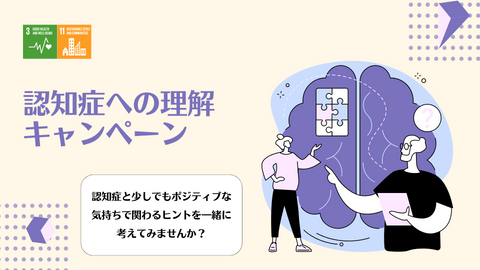
【Special offer for the first 50 people!】Understanding Dementia Campaign - Learn more about dementia -
Related SDGs(17 Goals)
*The gift presentation has reached its capacity. You can still answer the quiz. We look forward to your participation.
Dementia is not someone else's problem
According to the Cabinet Office, one in five people aged 65 and over, approximately 20%, are expected to have dementia by 2025. Now that anyone can become a dementia patient or a supporter of a dementia patient, let's deepen our understanding of dementia and think about tips for interacting with it effectively.
If a family member or close friend develops dementia
Dementia is a very common illness. If a family member or close friend develops dementia, it is important to treat them in a way that gives them as much peace of mind as possible, to respect them as "that person," and to watch over them even if it takes time for them to do things themselves. However, symptoms such as memory loss and the inability to do things they used to be able to do can make support difficult and emotionally burdensome. To protect not only the affected person but also your own health, it is important to skillfully reduce the burden of support.
How to reduce the burden of support
- Have time for hobbies and other activities that are important to you, outside of caregiving.
- Expand your network to obtain information.
- Know what the person with dementia can do now and value it.
- Consult reliable institutions, people, and organizations at any time.
- Actively use services such as long-term care insurance.
Cooperation as a member of the local community
One of the behavioral and psychological symptoms of dementia patients is wandering. Even if you don't have a close relative with dementia, deepening your knowledge of dementia as a member of the local community and supporting the prevention of accidents and missing persons due to wandering is a very important action to protect the lives of those affected.
Towards understanding dementia
Dementia symptoms are divided into two categories: "core symptoms" and "behavioral and psychological symptoms." Core symptoms are those that occur directly as a result of the death of brain nerve cells, such as memory impairment, disorientation, and impaired understanding and judgment. Behavioral and psychological symptoms, on the other hand, refer to anxiety and agitation, hallucinations, and depressive states that arise from a combination of various factors such as the person's original personality, environment, and human relationships, as well as wandering caused by these symptoms.
Dementia Prevention
Dementia can affect anyone, but Alzheimer's disease and vascular dementia are strongly associated with lifestyle diseases. Eating a diet rich in vegetables, fruits, and seafood, getting regular exercise, reducing stress, and leading a life that encourages active thinking are said to help prevent dementia.
As an individual, a family member, and a member of the local community, let's deepen our correct understanding to effectively deal with dementia and create a supportive community.
Quiz
Special benefits for the first 50 people! "Dementia Quiz"
-
The first 50 people who answer all questions correctly in the dementia quiz can choose between a 100-yen Amazon gift certificate or a donation.
*The gift will end once the capacity is reached.
*You can try the quiz as many times as you like! (The gift is limited to one per person.)
Delivery of prizes
- Applies to those who answer all questions (5 questions) correctly in the quiz.
- Prizes are limited to one per person.
- We will send an exchange guide to the email address registered in your member information.
- Please note that delivery may be delayed due to our circumstances.
Notes
- This quiz can only be used on computers and smartphones. You cannot answer from mobile phones other than smartphones.
- This page is as of November 1, 2024. The contents described are subject to interruption, cancellation, or change without notice.
- This quiz is conducted by GOYOH Co., Ltd. For inquiries, please click here.
- Amazon.co.jp is not a sponsor of this project.
- Amazon does not accept inquiries about this project. Amazon, Amazon.co.jp and the Amazon.co.jp logo are trademarks of Amazon.com, Inc. or its affiliates.
Was this article helpful?
【Special offer for the first 50 people!】Understanding Dementia Campaign - Learn more about dementia -
*The gift presentation has reached its capacity. You can still answer the quiz. We look forward to your participation.
Dementia is not someone else's problem
According to the Cabinet Office, one in five people aged 65 and over, approximately 20%, are expected to have dementia by 2025. Now that anyone can become a dementia patient or a supporter of a dementia patient, let's deepen our understanding of dementia and think about tips for interacting with it effectively.
If a family member or close friend develops dementia
Dementia is a very common illness. If a family member or close friend develops dementia, it is important to treat them in a way that gives them as much peace of mind as possible, to respect them as "that person," and to watch over them even if it takes time for them to do things themselves. However, symptoms such as memory loss and the inability to do things they used to be able to do can make support difficult and emotionally burdensome. To protect not only the affected person but also your own health, it is important to skillfully reduce the burden of support.
How to reduce the burden of support
- Have time for hobbies and other activities that are important to you, outside of caregiving.
- Expand your network to obtain information.
- Know what the person with dementia can do now and value it.
- Consult reliable institutions, people, and organizations at any time.
- Actively use services such as long-term care insurance.
Cooperation as a member of the local community
One of the behavioral and psychological symptoms of dementia patients is wandering. Even if you don't have a close relative with dementia, deepening your knowledge of dementia as a member of the local community and supporting the prevention of accidents and missing persons due to wandering is a very important action to protect the lives of those affected.
Towards understanding dementia
Dementia symptoms are divided into two categories: "core symptoms" and "behavioral and psychological symptoms." Core symptoms are those that occur directly as a result of the death of brain nerve cells, such as memory impairment, disorientation, and impaired understanding and judgment. Behavioral and psychological symptoms, on the other hand, refer to anxiety and agitation, hallucinations, and depressive states that arise from a combination of various factors such as the person's original personality, environment, and human relationships, as well as wandering caused by these symptoms.
Dementia Prevention
Dementia can affect anyone, but Alzheimer's disease and vascular dementia are strongly associated with lifestyle diseases. Eating a diet rich in vegetables, fruits, and seafood, getting regular exercise, reducing stress, and leading a life that encourages active thinking are said to help prevent dementia.
As an individual, a family member, and a member of the local community, let's deepen our correct understanding to effectively deal with dementia and create a supportive community.
Quiz
Special benefits for the first 50 people! "Dementia Quiz"
-
The first 50 people who answer all questions correctly in the dementia quiz can choose between a 100-yen Amazon gift certificate or a donation.
*The gift will end once the capacity is reached.
*You can try the quiz as many times as you like! (The gift is limited to one per person.)
Delivery of prizes
- Applies to those who answer all questions (5 questions) correctly in the quiz.
- Prizes are limited to one per person.
- We will send an exchange guide to the email address registered in your member information.
- Please note that delivery may be delayed due to our circumstances.
Notes
- This quiz can only be used on computers and smartphones. You cannot answer from mobile phones other than smartphones.
- This page is as of November 1, 2024. The contents described are subject to interruption, cancellation, or change without notice.
- This quiz is conducted by GOYOH Co., Ltd. For inquiries, please click here.
- Amazon.co.jp is not a sponsor of this project.
- Amazon does not accept inquiries about this project. Amazon, Amazon.co.jp and the Amazon.co.jp logo are trademarks of Amazon.com, Inc. or its affiliates.